Arabidopsis is a small research plant, not a magic detector. The useful scale runs from the whole removable pot down to the root hairs that actually meet the soil.
where the signal would beginA confocal fluorescence view of Arabidopsis root hairs. This is a biological reference image, not BioLume output or experimental data.
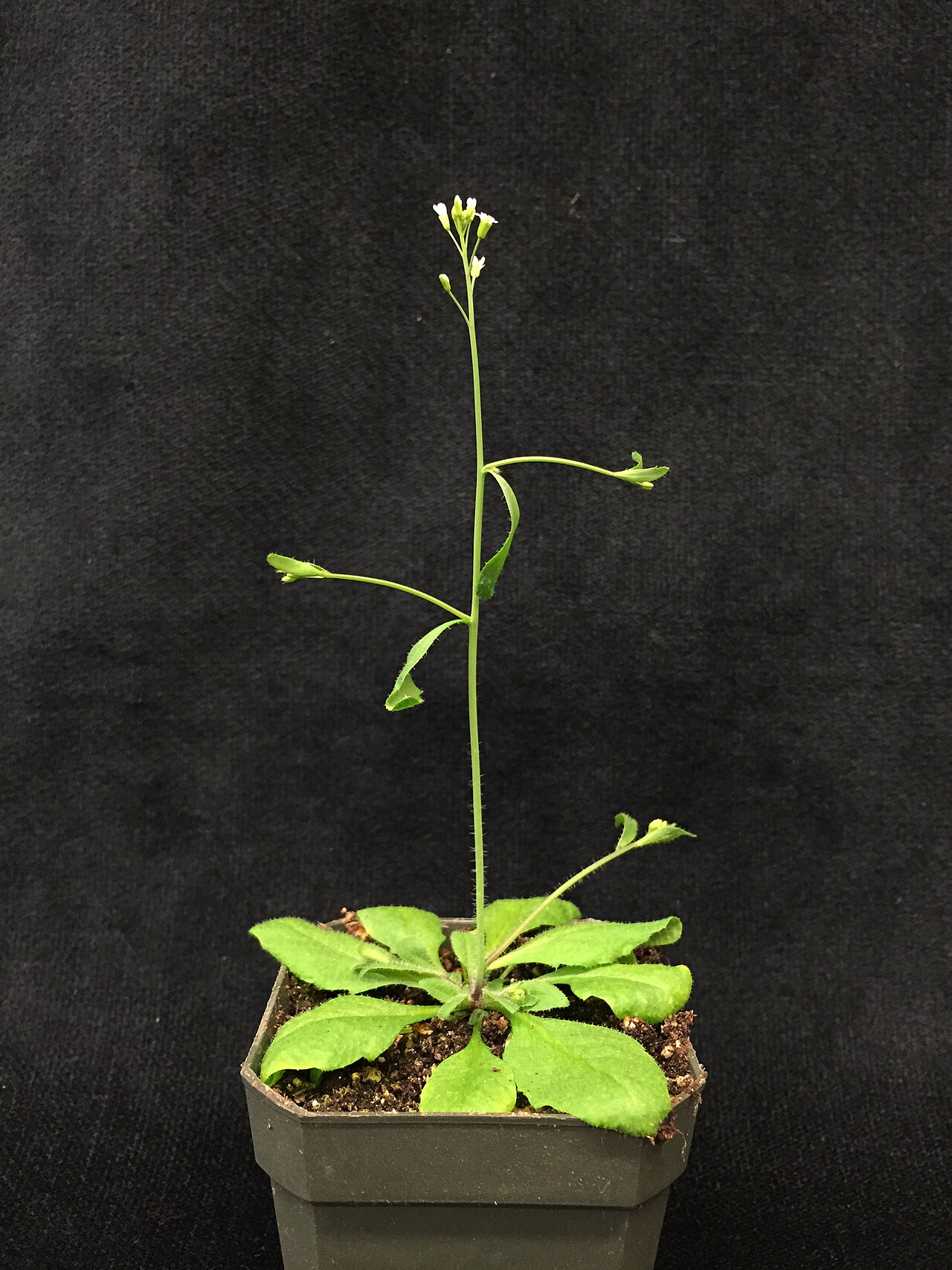
G Lens Microscopist and Megan Gerber · source · CC BY 4.0the kind of chassis I meanA flowering Arabidopsis plant, included as a model-organism reference rather than a picture of the proposed system.
Frost Museum · source · CC BY 2.0
signal audit
Four columns I do not want to blur together
The useful question is not whether plants can report signals - they can. The proof problem is whether one selected contaminant can generate a repeatable, specific output in realistic soil without confusing ordinary plant stress for pollution.
Route one root-zone signal into a field-readable warning
The proposal combines a contaminant-responsive regulatory element, a tissue-aware gate, and standardized imaging in a removable non-food plant module.
likely failure
Specificity, bioavailability, and signal stability
Soil pH, moisture, organic matter, plant age, other stresses, transgene silencing, and mixed pollutants could all weaken or imitate the intended signal.
first useful readout
A blinded dose-response study with stress controls
One analyte and one chassis must outperform clean, drought, salt, nutrient, heat, pathogen, and mixed-soil controls before any contained field pilot is justified.
proposed signal chain
Make every photon answer a specific question
The first version deliberately narrows the problem: one pre-selected analyte class, one non-food model plant, and one calibrated output channel.
01 · Target definition
Select one analyte before selecting a reporter
The proposal should begin with a contaminant that has a plausible responsive promoter or transcription-factor pathway. “General pollution” is not a valid target because general stress would produce unusable ambiguity (Kovalchuk et al., 2008; Hernández-Allica et al., 2015; Liu et al., 2022).
02 · Reporter layer
Choose output for measurement quality
Luciferase, fluorescence, pigment, or autoluminescence should be compared for background expression, response time, tissue penetration, energy burden, and compatibility with inexpensive imaging (Mitiouchkina et al., 2020; Khakhar et al., 2020).
03 · Signal gating
Require location, timing, and exposure agreement
A useful circuit should reject signals that appear in the wrong tissue, without the expected timing, or under non-target stress. Long-distance plant signaling is another reason location alone may not be specific (Toyota et al., 2018). A second marker or logical gate is proposed to reduce false positives.
04 · Readout and confirmation
Standardize the camera, then verify chemically
Fixed exposure, calibration references, matched control plants, and repeated imaging would convert brightness into a relative warning map. A positive plant signal would direct laboratory sampling - not declare a site safe or unsafe.
acceptance window
Write the pass/fail rules before the camera turns on
These are proposed go/no-go thresholds for an early controlled study, not measured results. They should be revised with a domain expert before experimental use.
Measure
Minimum signal for continued development
Stop or redesign condition
Target response
At least a threefold median reporter increase over matched clean-soil controls after normalization for plant size.
Target exposure cannot be distinguished from controls across repeated batches.
Dose ordering
Monotonic response across at least five pre-registered bioavailable concentrations.
Signal direction changes unpredictably or saturates below the useful range.
Specificity
No more than 10% positive classifications across the combined non-target stress panel.
Drought, salinity, heat, nutrient stress, or pathogens regularly reproduce the target signal.
Repeatability
Within-condition coefficient of variation at or below 25% across independent growth batches.
Plant-to-plant variation overwhelms the exposure effect.
Confirmation
Blinded reporter classification agrees with an independent chemical assay in at least 90% of test samples.
The plant map does not improve sampling decisions above a pre-registered baseline.
Containment
No viable seed, pollen, or plant material detected outside the removable test module.
Containment cannot be demonstrated under the intended handling conditions.
containment interlocks
The sensor cannot become a second contamination problem
Containment, false-positive control, and independent confirmation are system requirements rather than optional later additions.
Chassis
Non-food and removable
Use contained model or ornamental plants, sterile lines where possible, and removable modules rather than direct release into farmland.
Lock exposure settings, time of day, geometry, reference targets, plant age, and control placement before comparing brightness.
Lifecycle
Recover every organism
Collect seeds, pollen, plant waste, and growth medium; monitor trait stability and define a kill-or-remove process before deployment.
calibration sequence
Bench first. Real soil much later.
Progression stops whenever a specificity, stability, containment, or confirmation gate fails.
Target and promoter selection
Choose one analyte, one chassis, and candidate regulatory elements. Define clean and non-target controls before construction.
Reporter comparison
Compare brightness, background, timing, metabolic burden, and tissue localization under controlled expression. Transient expression can screen reporter candidates before stable line development (Leuzinger et al., 2013).
Growth-chamber calibration
Measure blinded dose-response curves across known concentrations and independent biological replicates.
False-positive challenge
Apply drought, salt, heat, nutrient, pathogen, mechanical, and mixed-stress controls.
Realistic soil matrix
Vary pH, moisture, organic matter, clay content, and contaminant mixtures while comparing chemical bioavailability.
Contained pilot
Only after earlier gates pass, test removable modules with standardized imaging and confirm every classification chemically.
source register
What the proposal is standing on
These papers support separate mechanisms and measurement approaches. None of them proves that my full BioLume Sentinel idea works.
Kovalchuk, I. et al. “Transgenic Plants as Sensors of Environmental Pollution Genotoxicity.” Sensors, 2008. Source
Mitiouchkina, T. et al. “Plants with Genetically Encoded Autoluminescence.” Nature Biotechnology, 2020. DOI
Khakhar, A. et al. “Building Customizable Auto-Luminescent Luciferase-Based Reporters in Plants.” eLife, 2020. DOI
Wong, M. H. et al. “Nitroaromatic Detection and Infrared Communication from Wild-Type Plants Using Plant Nanobionics.” Nature Materials, 2016. DOI
Hernández-Allica, J. et al. “Heavy Metal Whole-Cell Biosensors Using Eukaryotic Microorganisms: An Updated Critical Review.” Frontiers in Microbiology, 2015. DOI
Liu, Y. et al. “Biological and Molecular Components for Genetically Engineering Biosensors in Plants.” BioDesign Research, 2022. DOI
Toyota, M. et al. “Glutamate Triggers Long-Distance, Calcium-Based Plant Defense Signaling.” Science, 2018. DOI
Leuzinger, K. et al. “Efficient Agroinfiltration of Plants for High-Level Transient Expression of Recombinant Proteins.” Journal of Visualized Experiments, 2013. DOI
visual note: the mechanism diagram is my own HTML/CSS sketch. the two photos are real reference images; full credits and licenses are listed above and in IMAGE_CREDITS.md.